The Human Cost of the Thai–Cambodian Border Conflict: How Villagers Are Paying the Highest Price
While politicians debate sovereignty and military strategies, it is the ordinary villagers who bear the greatest burden. Their stories reveal the true cost of the conflict measured not only in casualties, but much more
 Latoya Thea
For decades, the Thai–Cambodian border has been a place where cultures, families, and economies have intertwined. Farmers crossed local checkpoints to sell produce, traders depended on daily commerce, and communities on both sides shared languages, traditions, and family ties. Yet when the French Colonial Era Induced territorial disputes escalated into armed clashes, these same villages became the front line of a conflict they neither started nor wanted. A snapshot of the timeline of the latest round of conflict
May 28, 2025 – Skirmish near Preah Vihear temple killed one Cambodian soldier; both sides blamed each other for starting it. (Britannica; CSIS)
Jul 23, 2025 – A Thai soldier was badly hurt after stepping on a PMN-2 landmine in Nam Yuen district, Ubon Ratchathani, an immediate trigger for the following day's fighting.
Jul 24–28, 2025 – Full-scale clashes broke out near Ta Muen Thom temple; Cambodian rocket fire reportedly hit Thai homes, a hospital, and a gas station; Thailand launched F-16 airstrikes with over 35 deaths and thousands displaced as a consequence.
Jul 28, 2025 – Unconditional ceasefire agreed in Kuala Lumpur after five days of fighting that killed dozens and displaced tens of thousands.
Dec 8, 2025 – Fighting resumed after the truce collapsed; a Thai soldier was wounded by Cambodian gunfire, as reported by CNBC.
Dec 9, 2025 – Two more Thai soldiers are killed in renewed clashes, raising Thai military deaths to three, according to Gulf News.
Dec 13, 2025 – Cambodia's Defence Ministry said Thai fighter jets carried out airstrikes despite a disputed US-brokered ceasefire claim.
Dec 14, 2025 – First civilian death reported in the reignited conflict; Thailand accused Cambodia of firing into civilian areas and imposed a curfew in Trat Province.
Dec 20, 2025 – Thai airstrikes damaged a bridge between Cambodia's Oddar Meanchey and Siem Reap provinces, as reported by Al Jazeera.
Dec 22, 2025 – Fresh clashes erupted even as ASEAN convened peace talks; Cambodia accused Thailand of F-16 bombings in Banteay Meanchey and the use of "toxic gas" near Prey Chan village. Reports from Cambodia put the death toll 40 and displaced people at almost a million.
Jan 6, 2026 – Thailand's army said Cambodian forces violated the 10-day-old truce, firing mortars into Ubon Ratchathani and wounding a Thai soldier.
Dec 27, 2025 – Second ceasefire signed at Ban Pakkad checkpoint, ending 20 days of fighting that had killed at least 101 people and displaced over half a million, as reported by CNN, AOL and Reuters.
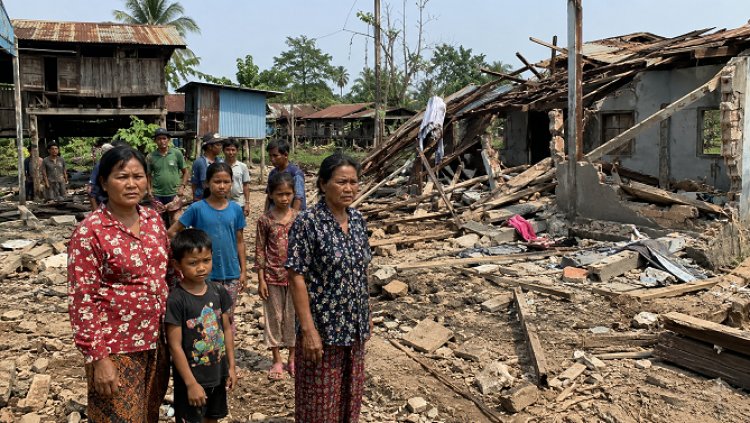
While political leaders debate sovereignty and military strategy, it is the ordinary villagers who bear the greatest burden. Their stories reveal that the true cost of the conflict is measured not only in casualties, but also in lost homes, broken livelihoods, interrupted education, and a lingering fear that may last for generations.
Villages Turned Into Front Lines
Border communities in Thailand and Cambodia are scattered across forests, rice fields, and mountain foothills near disputed territories such as the ancient temple complexes of Preah Vihear, Ta Moan Thom, and Ta Krabey. When fighting erupts, these peaceful farming communities suddenly find themselves within range of artillery and military operations.
Reuters reports that thousands of families have been forced to abandon homes that have been in their families for generations. Entire villages have been evacuated with little warning, leaving behind livestock, crops, machinery, and personal possessions. Some residents have returned only to find damaged homes or farmland that can no longer be safely cultivated because of unexploded ordnance or military restrictions.
Agriculture Comes to a Standstill
Most border residents rely on farming as their primary source of income. Rice paddies, cassava fields, rubber plantations, fruit orchards, and livestock require constant attention throughout the growing season.
Conflict disrupts this cycle in several ways:
- Farmers cannot safely reach their land.
- Irrigation systems go unrepaired.
- Harvests are delayed or abandoned.
- Livestock may be left unattended or sold at a loss.
- Local agricultural markets cease operating.
For families living from one harvest to the next, even a few weeks of displacement can erase an entire year's income. Unlike businesses in urban areas, rural households often have few alternative sources of employment.
Schools Fall Silent
Children are among the conflict's most vulnerable victims.
Schools near contested areas frequently suspend classes during periods of violence. Some are converted into evacuation centers or emergency shelters, while others become inaccessible because roads are closed or considered unsafe.
Parents face impossible choices between protecting their children and maintaining any sense of educational continuity. Months of interrupted schooling can have lasting effects on literacy, academic progress, and future employment opportunities.
Beyond academics, children often experience anxiety from witnessing military activity, hearing explosions, or being separated from familiar surroundings.
Healthcare Becomes Harder to Reach
Border conflicts place enormous strain on local healthcare systems.
Hospitals and clinics must simultaneously care for displaced civilians, emergency injuries, and routine medical needs. Transport routes become unreliable, making it difficult for pregnant women, elderly residents, and chronically ill patients to receive treatment.
Medical supply chains may also be disrupted, leaving shortages of essential medicines and equipment. During earlier fighting, damage to civilian infrastructure, including hospitals, highlighted how quickly healthcare services can be overwhelmed.
The Collapse of Local Economies
Many border towns depend on cross-border trade.
Before tensions escalated, merchants regularly transported food, household goods, construction materials, and agricultural products between Thailand and Cambodia. Local restaurants, markets, transport operators, and small shops all benefited from this daily movement.
Border closures have dramatically reduced this economic activity.
Small businesses that once served cross-border customers have experienced steep declines in revenue. Truck drivers, market vendors, currency exchangers, and hotel owners have all been affected as checkpoints remain restricted or closed for extended periods.
For communities already operating on narrow profit margins, these disruptions can threaten their long-term survival.
Families Separated by Borders
The international border often divides communities whose social ties long predate modern political boundaries.
Many families have relatives living on both sides. Weddings, funerals, religious festivals, and family gatherings become impossible when crossings are suspended.
According to CamboJA News, some migrant workers have also been forced to return home unexpectedly, leaving employers short of labor while reducing income for families who depend on wages earned across the border. Labor organizations and humanitarian groups have noted continuing challenges for displaced workers seeking stable employment after returning home.
Psychological Trauma That Lingers
The emotional consequences of conflict are often less visible than physical destruction.
Residents describe living with constant uncertainty and unanswered questions:
- Will fighting begin again?
- Is it safe to return home?
- Will children be able to continue school?
- Will the next planting season be possible?
Repeated evacuations create chronic stress, particularly among elderly residents who may have experienced previous conflicts along the border.
Children exposed to repeated displacement can carry emotional scars long after the guns fall silent.
Humanitarian Challenges
Humanitarian agencies have responded by providing emergency shelter, food, clean water, sanitation, healthcare, and psychosocial support to displaced families.
However, relief efforts face numerous challenges:
- Large numbers of displaced people.
- Continued security risks.
- Difficulty accessing remote villages.
- Damage to roads and infrastructure.
- Uncertainty over when families can safely return.
Assessments by international organizations like the United Nations indicate that hundreds of thousands of people were displaced during successive waves of fighting, creating one of the region's largest humanitarian emergencies in recent years.
Hope for Recovery
Despite the hardship, many villagers express a common desire: peace rather than politics.
Most residents simply want to cultivate their land, educate their children, trade with their neighbors, and rebuild their communities. Their livelihoods depend less on where a boundary line is drawn than on stability and the ability to live without fear.
Though ceasefire agreements have allowed many families to return, as reported by Reuters, but reconstruction remains slow. Homes must be repaired, farmland restored, schools reopened, and local economies revived, and most importantly, adequate measures must be taken to prevent future conflict before life can truly return to normal. Continued military deployments and new border security measures mean that uncertainty still hangs over many communities.
Conclusion
The Thai–Cambodian border conflict is often discussed in terms of maps, treaties, and military strategy. Yet its deepest impact is found in the villages scattered along the frontier.
Every abandoned rice field represents a family's lost income. Every closed school interrupts a child's future. Every empty market reflects an economy struggling to survive. Behind every headline about troop movements are ordinary people whose greatest wish is not victory, but the chance to return home and live in peace.
Ultimately, any lasting resolution to the border dispute will be judged not only by diplomatic agreements or territorial settlements, but by whether the people who have endured the conflict can once again farm their land, educate their children, and rebuild lives free from the shadow of war.